

You do not need a sweeping transformation to build AI readiness in L&D. In fact, many organisations stall because they wait for a grand AI strategy that never lands. But forward thinking L&D leaders move anyway. They redesign workflows, clarify AI governance, and equip managers to lead human-AI skills in real work.
The conversation in 2026 has shifted. Practitioners no longer ask, “Can AI generate content?” Instead, they ask, “How do we build governed, sustainable workflow learning ecosystems?” So if your organisation feels cautious, you can still lead with a practical 30–60–90 day plan.
Let’s break it down.
The Minimum Viable AI-Ready L&D Stack
You do not need dozens of tools. You need clarity, guardrails, and measurable outcomes. A minimum viable AI-ready stack includes five elements:
1. Clear AI Governance
Start with simple policies that define:
- Approved AI tools
- Acceptable data inputs
- IP ownership rules
- Bias and quality checks
- Documentation standards
Strong AI governance builds trust. And trust accelerates adoption.
2. Curated, Secure Tools
Choose tools that integrate with your existing LMS and workflow systems. JLMS Cloud, for example, enables structured content delivery and performance support within a governed environment. That means you control access, data, and reporting while enabling experimentation.
3. Structured Data Foundations
AI works best with clean, tagged, and structured data. Organise learning assets, job aids, and performance resources so teams can find what they need fast.
4. Enablement and Training
Teach employees how to use AI responsibly. Focus on prompt design, validation skills, and ethical usage. Build human-AI skills, not just tool familiarity.
5. Measurement Framework
Track impact from day one. Define what success looks like before scaling.
Now let’s turn this into action.
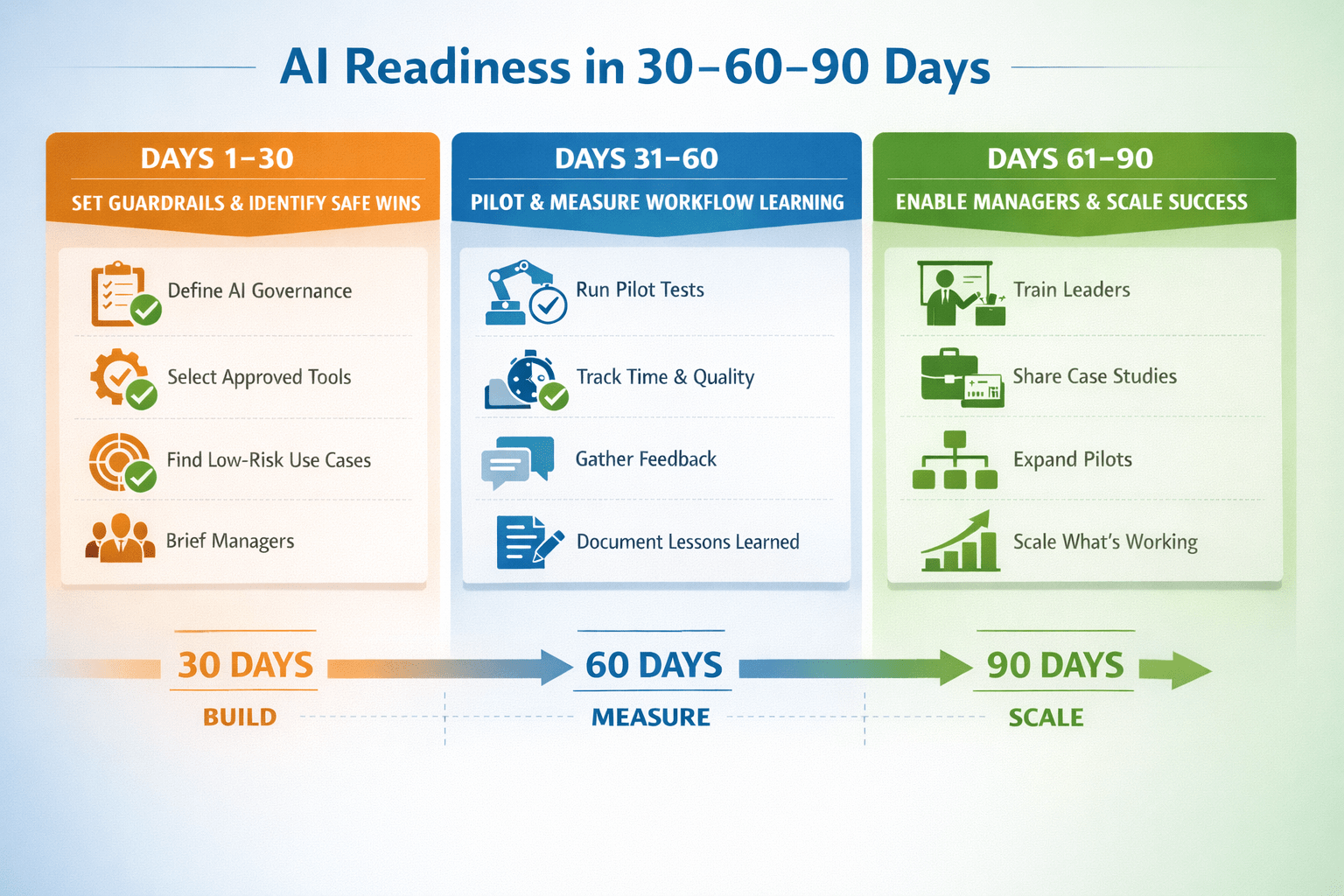
A 30–60–90 Day AI Readiness Plan
You can build real AI readiness in three phases.
Days 1–30: Set Guardrails and Identify Safe Wins
Start small but intentional.
- Define lightweight AI governance documentation
- Select 2 to 3 approved tools
- Identify low risk workflow learning opportunities
- Brief managers on expectations
Focus on use cases that improve learning in the flow of work.
Days 31–60: Pilot and Measure Workflow Learning
Run structured pilots using “safe wins.” Track time saved and quality signals. Gather feedback and refine prompts.
Document lessons learned because transparency strengthens governance.
Days 61–90: Enable Managers and Scale What Works
Train managers to coach performance in AI-augmented workflows. Share case studies internally. Expand successful pilots into broader teams.
Momentum builds confidence. Confidence drives adoption.
Five Safe Win Use Cases for AI in L&D
Not all AI use cases carry equal risk. These five offer quick value with manageable governance.
1. AI-Generated Job Aids
Turn existing procedures into concise job aids. Employees get instant clarity and performance improves.
2. Coaching Prompts for Managers
Provide structured coaching questions based on role expectations. Managers guide performance more consistently.
3. Practice Scenarios and Simulations
Create safe, AI-powered practice conversations. Teams develop human-AI skills without real world risk.
4. Intelligent Search and Curation
Use AI to tag and surface relevant resources inside your LMS. This strengthens learning in the flow of work.
5. Real-Time Feedback Loops
Analyse learner feedback and performance data. Identify skill gaps quickly and adjust programmes faster.
Each use case supports workflow learning rather than adding more content.
Governance Essentials You Must Document
AI governance does not need to feel heavy. But it must feel clear.
Document:
- Data privacy standards
- Intellectual property ownership
- Bias mitigation processes
- Human review requirements
- Evaluation criteria
Clarity reduces fear. And reduced fear increases responsible adoption.
Platforms like JLMS Cloud support structured permissions, content control, and reporting, which makes AI governance operational instead of theoretical.
Manager Enablement in an AI-Augmented Workplace
Managers shape behaviour more than any policy.
Equip them to:
- Coach employees on validating AI outputs
- Reinforce ethical AI usage
- Focus on performance outcomes, not tool novelty
- Encourage experimentation within guardrails
When leaders normalise AI-augmented workflows, adoption accelerates. And when they model critical thinking, quality improves.
Your Simple AI Adoption Dashboard
Avoid vanity metrics. Instead, track meaningful indicators:
Usage Metrics
- Active users
- Frequency of AI-supported workflows
Quality Signals
- Accuracy ratings
- Manager validation scores
- Reduced rework
Efficiency Gains
- Time saved per task
- Faster content creation cycles
Performance Outcomes
- Sales conversion rates
- Compliance improvements
- Productivity indicators
JLMS Cloud centralises learning data and workflow engagement, so you can connect AI usage to measurable business impact.
You Do Not Need a Big AI Programme
You need direction, governance, and practical execution.
AI readiness starts with workflow learning. It grows through strong AI governance. And it scales when managers build human-AI skills inside everyday work.
So instead of waiting for a sweeping transformation, build momentum in 90 days. Lead with clarity. Measure what matters. And design learning ecosystems that blend human judgment with AI capability.
That is how modern L&D leads, even when the organisation hesitates.
Sources:
Discover more from JZero Solutions
Subscribe to get the latest posts sent to your email.

No responses yet