

“Skills-based organization” sounds compelling, but execution separates ambition from impact. As organisations move from headcount to skill count, L&D leaders must build a practical system that defines, validates, and reports on real workforce capability.
Industry research now positions 2026 as the year skills strategies must mature. At the same time, AI value follows workflow redesign, so leaders must clarify which skills drive performance. And executives expect faster proof of impact, so L&D must show measurable skill growth, not just course completions.
So how do you operationalise this shift in a way that works inside your existing learning ecosystem?
Here is a practical playbook, grounded in how JLMS Cloud can support it.
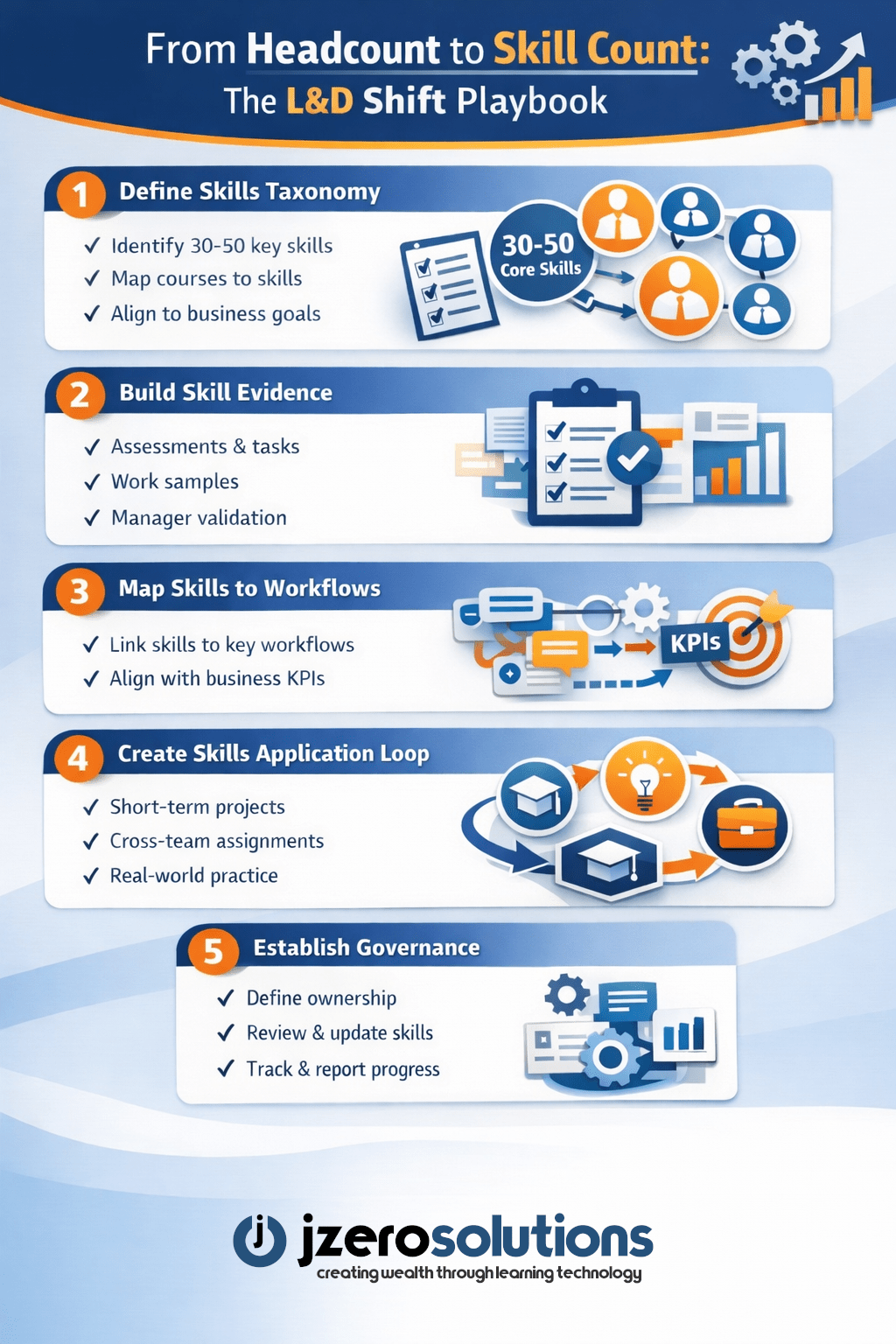
1. Define Your Headcount to Skill Count Framework With a Practical Skills Taxonomy
A skills taxonomy should start simple. Do not attempt to catalogue every possible capability.
Instead:
- Identify 30 to 50 high impact skills
- Focus on skills tied directly to key workflows
- Prioritise revenue, operational, digital, and leadership capabilities
- Align each skill to clear business outcomes
This minimum viable taxonomy gives structure without overwhelming the organisation.
In JLMS Cloud, you can operationalise this by:
- Mapping each course or pathway to one or more defined skills
- Using tags or custom fields to align learning to specific capabilities
- Structuring curricula around skill development rather than job titles
This configuration turns your LMS from a content library into a structured skills development engine.
2. Build Skills Intelligence With Structured Evidence
A skills-based organization requires proof. Self declared expertise does not create confidence at board level.
You need consistent evidence such as:
- Assessment scores aligned to specific skills
- Scenario based testing for applied knowledge
- Assignment submissions or work based tasks
- Manager validation or structured sign off
JLMS Cloud provides the mechanisms to support this through:
- Built in assessments and graded quizzes
- Assignment upload functionality
- Defined pass marks that represent proficiency thresholds
- Learning history stored at individual learner level
For example:
Skill: Data Interpretation
Mapped to: Advanced Sales Analytics pathway
Evidence: Assessment score above 80 percent plus scenario task completion
When you align courses and assessments to your skills taxonomy, the platform becomes a central evidence store. L&D teams can then generate reports that show which learners have met defined skill criteria. That reporting layer forms the backbone of practical skills intelligence and visible workforce capability.
The power comes from intentional mapping and disciplined governance, not from adding unnecessary complexity.
3. Map Skills to Workflows and Business KPIs
The shift from headcount to skill count only matters if it connects to performance.
Start by asking:
- Which workflows drive our core KPIs?
- Which skills enable each workflow?
- Where do we have gaps?
For example:
- Sales workflow → consultative selling, CRM analytics, AI assisted prospecting
- Operations workflow → process optimisation, automation oversight
- Product workflow → user research, agile execution
Once defined, map these skills directly to structured learning pathways inside JLMS Cloud.
You can:
- Build role specific or workflow specific curricula
- Assign mandatory skill aligned programmes
- Track completion and assessment performance by department
- Report on skill aligned learning uptake across business units
This approach transforms L&D reporting. Instead of showing attendance numbers, you show progress against priority workforce capability areas.
A consolidated view of learning, assessment, and progression data gives leaders clearer visibility into where skills exist and where development must accelerate.
4. Create a Skills Application Loop That Drives Mobility
A skills strategy must extend beyond courses. Employees need opportunities to apply and demonstrate capability in real work.
In practical terms, that means:
- Short term project assignments outside someone’s usual role
- Cross functional task groups solving specific business problems
- Temporary role expansions during transformation initiatives
- Structured stretch responsibilities agreed with managers
This is how organisations turn learning into applied capability.
The loop works like this:
- Identify a required skill gap
- Assign targeted learning through JLMS Cloud
- Validate skill through assessment
- Provide real work opportunities to apply the skill
- Capture evidence and update learner records
JLMS Cloud supports this cycle by enabling targeted enrolments, tracking assessment outcomes, storing assignment submissions, and reporting on validated progression. Although it is not a standalone talent marketplace, it provides the structured validation and reporting backbone that informs internal mobility decisions.
That clarity reduces reliance on job titles and increases confidence in skills data.
5. Govern the Shift From Headcount to Skill Count
Without governance, skills frameworks drift.
Define ownership clearly:
- HR defines enterprise level skill categories
- Business leaders validate workflow relevance
- L&D manages mapping and alignment within JLMS Cloud
- Data teams report on skills intelligence and workforce capability trends
Review your core 30 to 50 skills quarterly. Update definitions when workflows evolve. Retire outdated skills and introduce new ones aligned to AI enabled processes.
Centralised learning records, assessment data, and reporting within JLMS Cloud create a consistent development dataset. That consistency strengthens executive reporting and supports strategic workforce planning.
Why This Matters Now
Recent research from AIHR, TalentLMS, and Aon highlights three converging forces:
- Organisations must demonstrate measurable workforce capability
- AI investments require clear skill ownership and decision rights
- L&D teams face increasing pressure to prove impact
The shift from headcount to skill count is not theoretical. It is operational.
JLMS Cloud allows L&D leaders to configure structured skills taxonomies, align learning pathways to defined capabilities, validate proficiency through assessments, and report on skill aligned development at scale.
In the AI era, competitive advantage does not come from how many people you employ. It comes from what they can demonstrably do.
And that is the true meaning of headcount to skill count.
Sources:
Discover more from JZero Solutions
Subscribe to get the latest posts sent to your email.

No responses yet