

“AI Academy training” sounds inspiring, and many organisations now commit to it publicly. But without structure, clarity, and guardrails, large scale AI upskilling quickly turns into noise. L&D leaders sit right in the middle of this tension, because they must move fast while protecting quality, trust, and day to day productivity.
This challenge explains why AI academies trend across the L&D world right now. Many organisations are now pushing AI upskilling into the mainstream conversation. At the same time, leaders now reject pilot project theatre and ask for real workflow impact. Responsible AI training has also moved to the front, not the appendix.
So how do you train everyone on AI without creating chaos?
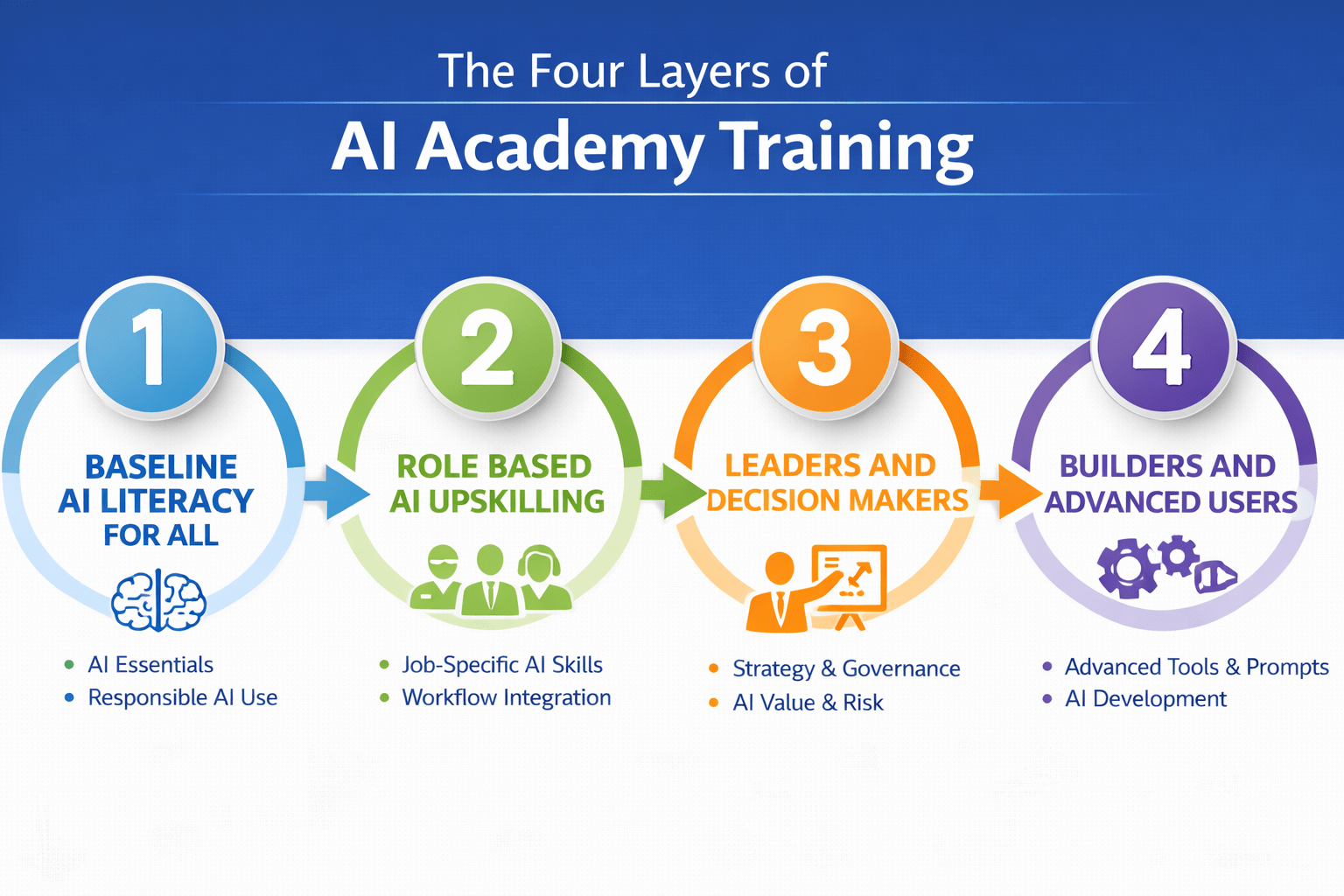
The Four Layers of AI Academy Training
Successful AI Academy training does not treat everyone the same. Instead, it layers learning based on responsibility and risk.
1. Baseline AI Literacy for All
Everyone needs a shared foundation, because AI touches daily work. This layer focuses on:
- What generative AI can and cannot do
- Where AI fits into everyday tasks
- What “responsible use” actually means in practice
This training builds confidence, but it also sets limits. People need clarity so they feel safe using AI at work.
2. Role Based AI Upskilling
After literacy comes relevance. Different roles use AI differently, so L&D must design learning around job reality.
Examples include:
- Sales teams improving proposals and call follow ups
- HR teams accelerating policy drafts and job descriptions
- Operations teams analysing patterns in documents and tickets
Because this learning maps to real tasks, adoption increases quickly.
3. Leaders and Decision Makers
Leaders need AI training too, but for different reasons. They shape priorities, budgets, and risk tolerance.
This layer focuses on:
- Where AI delivers real business value
- How to ask better questions of teams using AI
- How to govern AI use without blocking innovation
When leaders understand AI, they support learning instead of slowing it down.
4. Builders and Advanced Users
Some employees go further. They build prompts, workflows, and lightweight automations.
For this group, AI Academy training includes:
- Advanced prompting and evaluation
- Tool specific guidance
- Clear escalation paths for risk or uncertainty
This layer turns curiosity into capability, but it requires stronger guardrails.
Design AI Learning Around Workflows
AI training fails when it sits outside real work. L&D leaders now shift focus from courses to workflows.
Strong AI academies align learning with:
- Meetings, including preparation and follow ups
- Communication, such as emails and updates
- Documentation and knowledge capture
- Customer facing work and internal support
Because learners apply skills immediately, training feels useful, not theoretical.
Guardrails That Scale With Responsible AI Training
Responsible AI training must scale with adoption, not slow it down. Clear guardrails help people move faster, because they remove doubt.
Effective guardrails include:
- Simple rules on data boundaries
- Clear examples of safe and unsafe use
- Escalation paths when questions arise
When employees know where the lines are, they stop guessing and start using AI productively.
Community Mechanics That Drive Adoption
AI learning grows faster when people learn together. Communities turn training into momentum.
High impact AI academies often include:
- AI champions embedded in teams
- Open office hours for real questions
- Peer reviews of prompts and workflows
- Shared prompt libraries that evolve over time
These mechanics reduce dependency on L&D while increasing quality.
Measure What Actually Changes
Completion rates no longer tell the story. L&D leaders now track signals that reflect real work impact.
Better measures include:
- Cycle time reductions
- Quality improvements in outputs
- Reduced rework and duplication
- Tool adoption patterns across teams
These signals show whether AI Academy training changes how work gets done.
Why This Matters for L&D Leaders
Training everyone on AI will only accelerate. But chaos is not inevitable. With layered learning, workflow alignment, and strong communities, L&D can turn AI upskilling into a strategic advantage.
Platforms like JLMS Cloud support this shift by enabling structured academies, role based learning paths, governance controls, and meaningful analytics. When learning systems support real work, AI training moves from ambition to impact.
Evidence Links:
Discover more from JZero Solutions
Subscribe to get the latest posts sent to your email.

No responses yet