

Every so often, something comes along that makes you pause and think, “Hang on…this could change everything.” But Generative UI could transform elearning and SCORM.
Reading Google’s research blog on Generative UI was one of those moments for me.
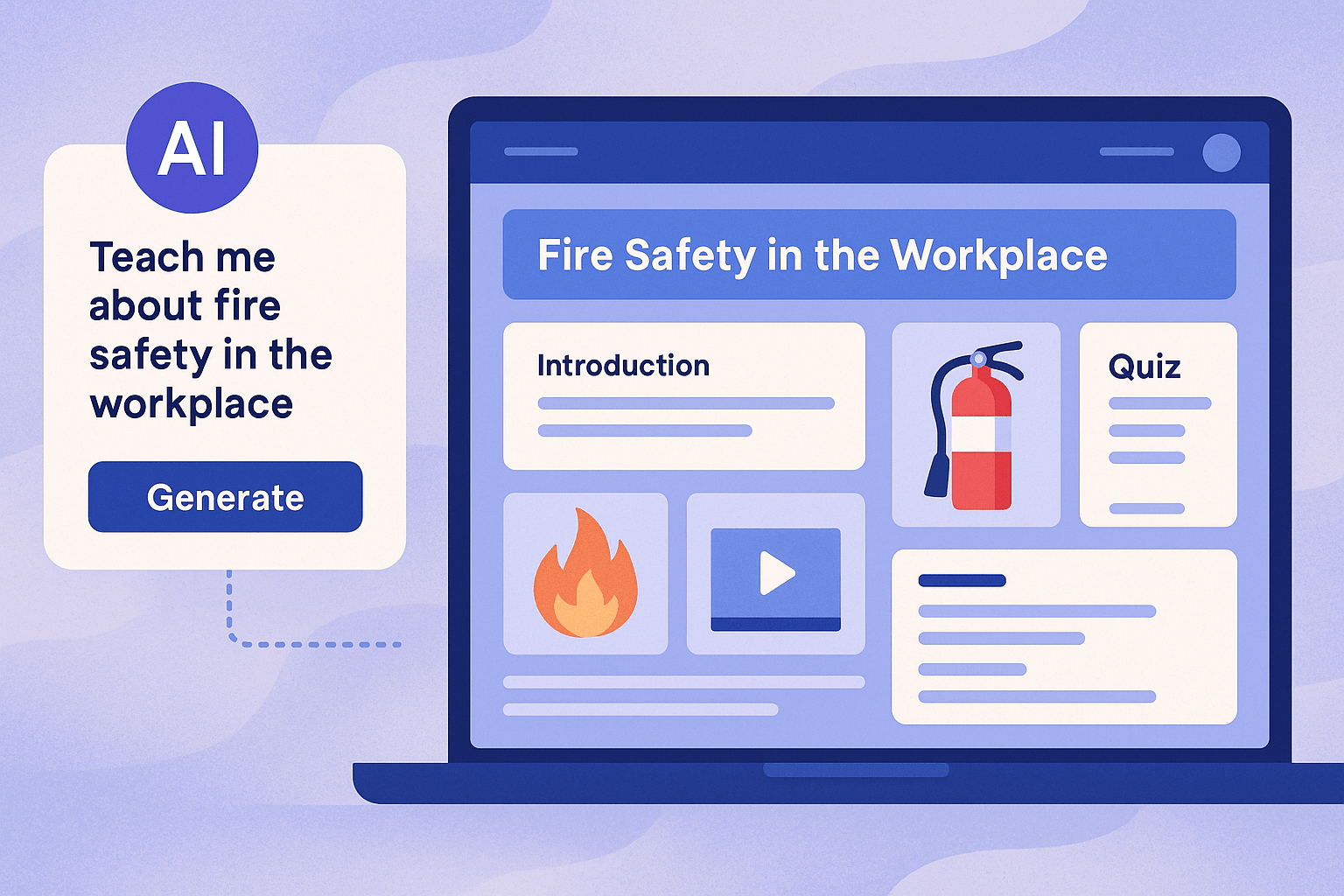
Not because it’s another shiny AI demo, but because it quietly points to a future where a learner might type a single prompt –
“Teach me about fire safety in the workplace.”
…and instead of getting a list of web links or a long AI chat response, an entire learning experience springs into life:
- A structured “course” with short explanations
- Interactive scenarios based on their role
- A quick knowledge check
- Usage data flowing back to an LMS or learning record store
All generated on the fly, just for them.
As someone who lives in the world of digital learning, I can’t look at that and not think about what it means for authoring tools, SCORM, and the way we design learning in general.
What Generative UI Actually Changes
In simple terms, Generative UI is about AI not just writing content, but building interfaces from a prompt:
- Layouts
- Buttons
- Interactions
- Entire mini-apps
Instead of designing every screen and interaction manually, we set the rules, constraints and goals, and the AI assembles the interface dynamically.
Now plug that into learning:
- The “prompt” becomes a learning need (e.g. “Help me understand fire safety in a small warehouse”).
- The model pulls from trusted content and designs a bespoke experience.
- The learner works through it as if it were any other eLearning module.
- Behind the scenes, we still track activity, measure outcomes, and show completion.
At that point, the line between “author” and “learner” starts to blur.
From Instructional Designer to Experience Orchestrator
I don’t think this kills the role of the instructional designer. But it definitely changes it.
Right now, most eLearning authoring processes look like this:
- Gather requirements.
- Write content.
- Design screens and interactions.
- Build everything slide by slide.
- Publish to SCORM, upload to LMS, repeat.
In a Generative UI world, it might look more like this:
- Define learning goals and outcomes.
- Set guardrails and templates:
- Approved content sources
- Interaction types (quizzes, scenarios, simulations)
- Brand/style and accessibility rules
- Configure how much the AI can adapt based on role, level, preferences.
- Let the system generate the experience – and then curate, tweak, and approve.
You’re not hand-crafting every screen. You’re orchestrating a system that can build many valid learning experiences from one well-defined brief.
And in some cases, the learner becomes a co-author:
- “Create a 10-minute refresher on manual handling for warehouse staff.”
- “Explain basic financial literacy to someone who’s just started their first job.”
The prompt doesn’t replace expertise, it activates it. That’s how Generative UI could transform elearning and SCORM.
Could Learners Really Author Their Own Courses?
Absolutely, in some scenarios I think they will.
Imagine this:
- A frontline worker about to start a shift with new machinery.
- They prompt: “Give me a quick safety briefing on using the new X2000 pallet stacker.”
- A new manager feeling out of their depth with HR conversations.
- They prompt: “Walk me through how to handle a performance review when someone is underperforming.”
The system could quickly and easily:
- Pull from vetted company policies and learning assets.
- Build a short, tailored experience: a mix of explanation, scenarios, and tasks.
- Track their journey and outcomes just like a traditional course.
Will that replace all structured programmes? Absolutely not.
But for just-in-time, task-specific, and personalised learning, it’s incredibly powerful. And it feels much closer to how people actually search for help today.
What Happens to SCORM in All This?
Here’s where it gets uncomfortable for our legacy standards.
SCORM assumes:
- Content is pre-packaged ahead of time.
- The structure is fixed when you publish.
- The tracking model is fairly simple: completion, score, a few interactions.
Generative UI assumes:
- The interface is created at run time.
- Two learners might see completely different flows, even from the same prompt.
- The experience can adapt mid-session based on what the learner does.
Those two worldviews don’t naturally line up.
The Likely Transitional Phase would be AI Inside a SCORM Shell
In the short term, I can see a lot of solutions doing this:
- Wrap an AI-generated experience inside a single SCORM package.
- The SCORM content loads a dynamic UI from an AI service.
- A bit of JavaScript acts as a bridge:
- The AI UI sends events like completed, passed, score, time spent.
- The SCORM layer converts those into normal SCORM calls.
To the LMS, it looks like any other SCO. Under the hood, it’s completely dynamic.
It’s a pragmatic step, but it’s also a bit of a fudge. You lose a lot of granularity and nuance.
I Think xAPI (and cmi5) Make More Sense
If you want to fully embrace dynamic, personalised interfaces, you really want something like xAPI:
- Every action can be expressed as a statement:
- [Learner] viewed [Fire safety explainer]
- [Learner] answered [Scenario Q2] [incorrectly]
- [System] increased difficulty to [Level 3]
- You could capture:
- The prompt used
- The model or configuration
- The UI style (“short-form video layout”, “text-first layout”)
- The exact path the learner took
And if you still need a “package and launch” standard for LMSs, cmi5 gives you that without SCORM’s rigid runtime limitations.
In other words: SCORM might remain for legacy compliance and simple modules, but the real story for AI-generated experiences is going to sit around xAPI and more modern specifications.
The Really Cool Bit: Personalised UI, Not Just Personalised Content
Generative UI takes us into the territory of personalising how the learning looks and feels.
Two people might have:
- The same learning goal (e.g. “understand basic fire safety”).
- The same core knowledge checks (to satisfy compliance).
…but see that content in completely different interfaces:
- A 21-year-old, social-media-native learner:
- Vertical, swipeable video clips
- Quick polls and reaction buttons
- Scenario “stories” that feel more like a feed
- A 55-year-old, reflective learner:
- Clean text and diagrams
- Clear sections, no distractions
- Printable summary at the end
Add in things like:
- Accessibility needs
- Language requirements
- Confidence with the topic
- Previous performance in similar content
…and you can start to imagine a world where the UI itself is an adaptive variable in the learning design.
The goal doesn’t change: safe, competent behaviour in the workplace.
The path, and the “wrapper” it comes in, absolutely does.
What About Governance?
Of course, this all comes with some very real challenges:
- Accuracy and safety
- For topics like fire safety, manual handling, data protection (the compliance ones), we can’t afford “creative” answers.
- That means tightly controlling sources, using approved content, and constraining what the model is allowed to generate.
- Audit and compliance
- If learning is personalised and dynamic, we still need to be able to answer:
- What exactly did this person see?
- What knowledge did we test?
- Was it aligned to policy and regulation?
- If learning is personalised and dynamic, we still need to be able to answer:
- Latency and cost
- Generating rich interfaces isn’t trivial. We’ll need smart caching and pre-generation for common needs, and live generation only where it adds real value.
- Learner-authored prompts and guardrails
- Giving learners the power to request learning on anything sounds attractive… until someone pushes into areas you don’t want the corporate learning platform to support.
- We’ll need good guardrails, filters, and role-based permissions there.
So… What Should L&D and Learning Tech Folks Be Doing Now?
I don’t think the takeaway is “throw out your authoring tools” or “SCORM is dead tomorrow”. Remember, we are talking about how Generative UI could transform elearning and SCORM…not replace it.
But I do think this is the moment to start shifting mindset:
- Get curious about prompt-driven learning
- Where in your organisation would “type a question → get a short, trackable experience” genuinely help people?
- Separate “experience design” from “screen building”
- Focus more on objectives, constraints, and guardrails.
- Let the tech handle more of the assembly over time.
- Invest in better tracking foundations
- If you’re still all-in on SCORM only, start exploring xAPI and cmi5.
- The more adaptive your learning gets, the more you’ll need a richer data story.
- Start small, in low-risk domains
- Use generative UI ideas in soft skills, onboarding, coaching-style content before you touch high-risk compliance areas.
- Keep the human in the loop
- AI can generate experiences.
- Humans still need to decide whether those experiences are ethical, accurate, and aligned with the culture you want to build.
For me, the exciting thing is not the novelty of AI building interfaces.
It’s the possibility that, for the first time, learners could genuinely author the experiences they need, at the moment they need them, while we still keep the structure, tracking and rigour that learning leaders care about.
As an industry, we’ve talked about “personalised learning” for years and seen some great attempts at getting there. But Generative UI could transform elearning and SCORM, and it feels like it might finally give us the tools to fully actualise it!
Discover more from JZero Solutions
Subscribe to get the latest posts sent to your email.

No responses yet