
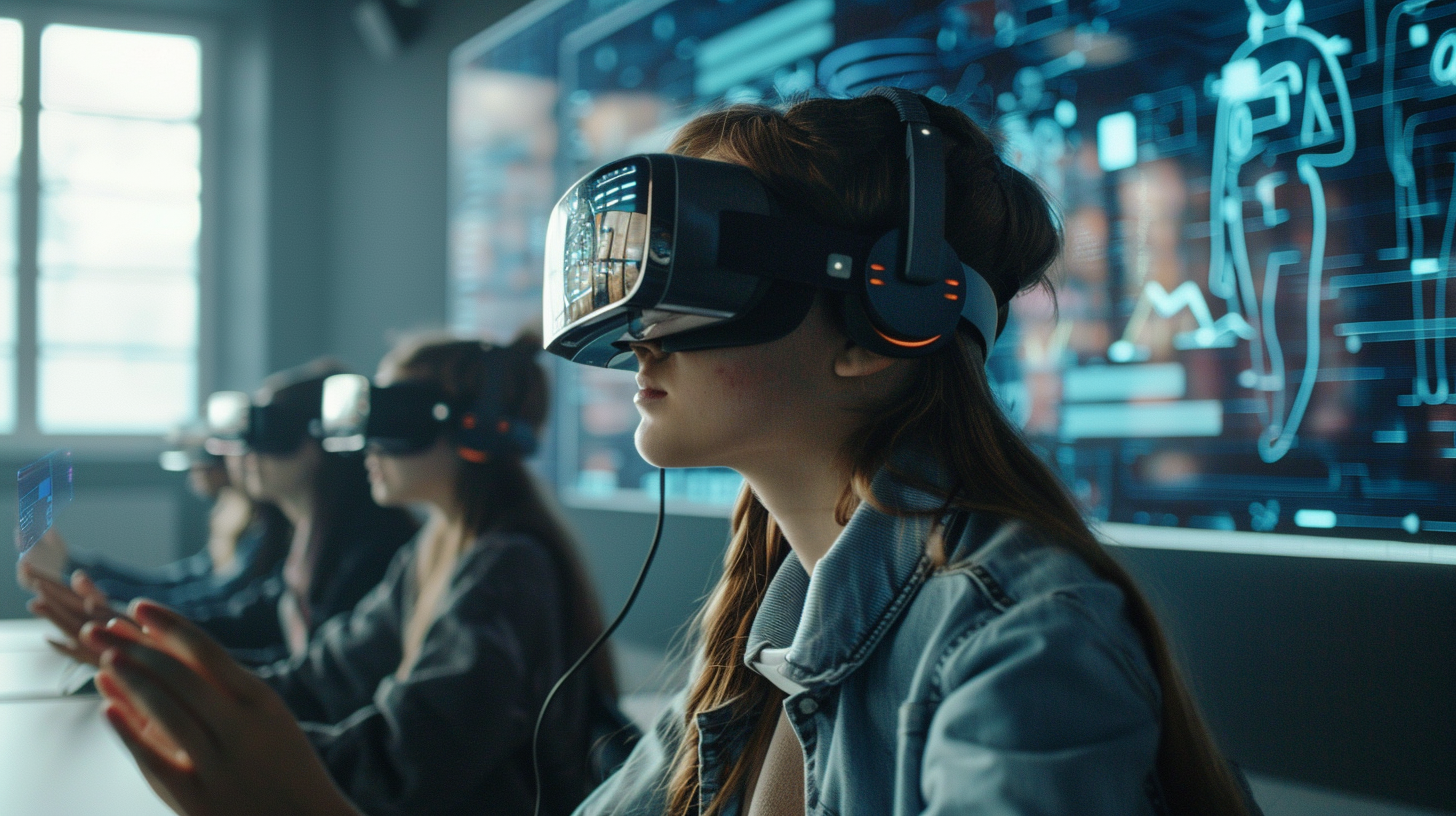
In recent years, Virtual Reality (VR) and Augmented Reality (AR) have been gaining momentum across various industries, from entertainment to healthcare. While these technologies are often associated with gaming and immersive media experiences, their potential impact on education and e-learning is equally profound. As Learning Management Systems (LMS) continue to evolve, the integration of VR and AR could represent the next frontier in delivering highly engaging and effective learning experiences. By 2030, these technologies may be the cornerstone of how LMS platforms function, transforming traditional e-learning into a more immersive, interactive, and personalized process.
What is VR and AR in Learning?
Before diving into their impact on LMS platforms, it’s essential to distinguish between VR and AR:
- Virtual Reality (VR) is a fully immersive experience where users wear headsets that take them into a completely digital world, cutting off sensory input from the real world. In education, VR allows learners to enter simulated environments, whether it’s a virtual science lab, a historic battlefield, or the human body’s circulatory system.
- Augmented Reality (AR), on the other hand, overlays digital information onto the real world, typically via mobile devices or AR glasses. This means learners can interact with their physical environment while receiving real-time digital enhancements. For example, AR can project historical artifacts in a classroom or guide users through complex tasks like engine repairs with step-by-step instructions overlaid on their field of vision.
How VR and AR Enhance Learning
At their core, VR and AR provide learners with a more engaging, hands-on experience. Research shows that people tend to remember more when they’re actively involved in learning rather than passively consuming information. VR and AR amplify this engagement by simulating real-life scenarios or augmenting physical spaces with additional data.
For example, imagine medical students practicing surgeries in a fully immersive VR operating room. They can make mistakes, learn from them, and repeat procedures without any real-world consequences. Similarly, AR can be used in engineering courses to overlay a 3D model of a machine part, enabling students to examine its components from every angle, enhancing their spatial understanding and problem-solving abilities.
Integration of VR and AR in LMS Platforms by 2030
By 2030, VR and AR technologies are expected to be fully integrated into LMS platforms, revolutionizing the way e-learning content is created, delivered, and consumed. Here are some key ways in which VR and AR could transform LMS platforms over the next decade:
- Immersive Simulations for Skill Training:
- LMS platforms will increasingly offer VR-enabled modules where learners can practice complex tasks in simulated environments. This could be particularly valuable for industries like healthcare, aviation, engineering, and military training, where real-world simulations are costly or risky.
- For instance, pilots could use VR simulations to train for emergency situations, while medical students could practice diagnosing patients in virtual clinical settings.
- AR for On-the-Job Training and Real-Time Assistance:
- AR, when integrated into an LMS, will play a crucial role in workplace training. Employees could use AR glasses or mobile apps to receive real-time guidance while performing tasks. This could significantly reduce onboarding time for new hires and minimize errors on the job.
- Imagine a technician repairing a complex piece of machinery with AR instructions guiding them through each step, reducing the need for in-person trainers or detailed manuals.
- Enhanced Collaboration and Social Learning:
- VR can also create virtual classrooms or meeting spaces where learners and instructors can interact as if they were physically present together. These virtual spaces would allow for collaboration, group discussions, and even peer-to-peer learning, which traditional online courses sometimes lack.
- Unlike traditional video calls or chatrooms, VR-powered classrooms will make learners feel more connected to their peers, encouraging engagement and improving retention rates.
- Personalized Learning Paths and Assessments:
- By 2030, LMS platforms will likely use AI alongside VR and AR to create personalized learning paths. For example, based on a learner’s progress, the LMS could adjust the difficulty of VR simulations or offer real-time AR tips to reinforce learning concepts.
- Assessments will also become more interactive and practical. Instead of taking a multiple-choice test, learners might have to navigate a VR environment to demonstrate their knowledge, making assessments more aligned with real-world tasks.
- Overcoming Accessibility Barriers:
- One of the current challenges of VR and AR is accessibility—mainly the cost of equipment and the technical skills required. However, as VR headsets and AR devices become more affordable and user-friendly by 2030, these barriers will diminish. LMS platforms will be able to offer VR/AR-powered learning to a broader audience, from university students to corporate trainees.
The Future is Immersive
By 2030, the integration of VR and AR into LMS platforms will likely be widespread, making e-learning more immersive, engaging, and effective. Learners will no longer be passive recipients of information; instead, they will actively participate in virtual simulations and augmented experiences that mirror real-world scenarios. These technologies promise to transform the learning landscape, making education more accessible, practical, and dynamic than ever before. As VR and AR continue to develop, the future of e-learning looks immersive and limitless.
Discover more from JZero Solutions
Subscribe to get the latest posts sent to your email.

No responses yet