

Employees already use AI at work. Many do it quietly, often outside official tools. This growing behaviour is known as shadow AI, and it is now a major challenge for organisations. For L&D leaders, this is not just a governance problem. It is a shadow AI training problem.
Recent research shows that 68% of organisations report employees using unapproved AI tools, often because training and guidance have not caught up with adoption.
The reality is simple. People are not trying to break rules. They are trying to work faster.
So instead of banning AI tools, organisations need a smarter approach. L&D can turn shadow AI into safe, productive AI capability across the workforce.
Why Shadow AI Is Rising
AI adoption is moving faster than governance. Employees discover powerful tools and start experimenting before policies exist.
Several forces drive this behaviour:
- Pressure to improve productivity
- Slow internal systems
- Lack of AI training
- Curiosity and experimentation
Surveys show over 70% of UK employees have used unapproved AI tools at work, often to save time on daily tasks.
But unmanaged AI use creates real risks, including:
- Data leakage
- Compliance breaches
- Security vulnerabilities
- Incorrect outputs influencing decisions
Security researchers also warn about prompt injection attacks, where hidden instructions manipulate AI tools into revealing data or performing unintended actions.
This is why AI governance now requires more than policy documents. It requires workforce literacy.
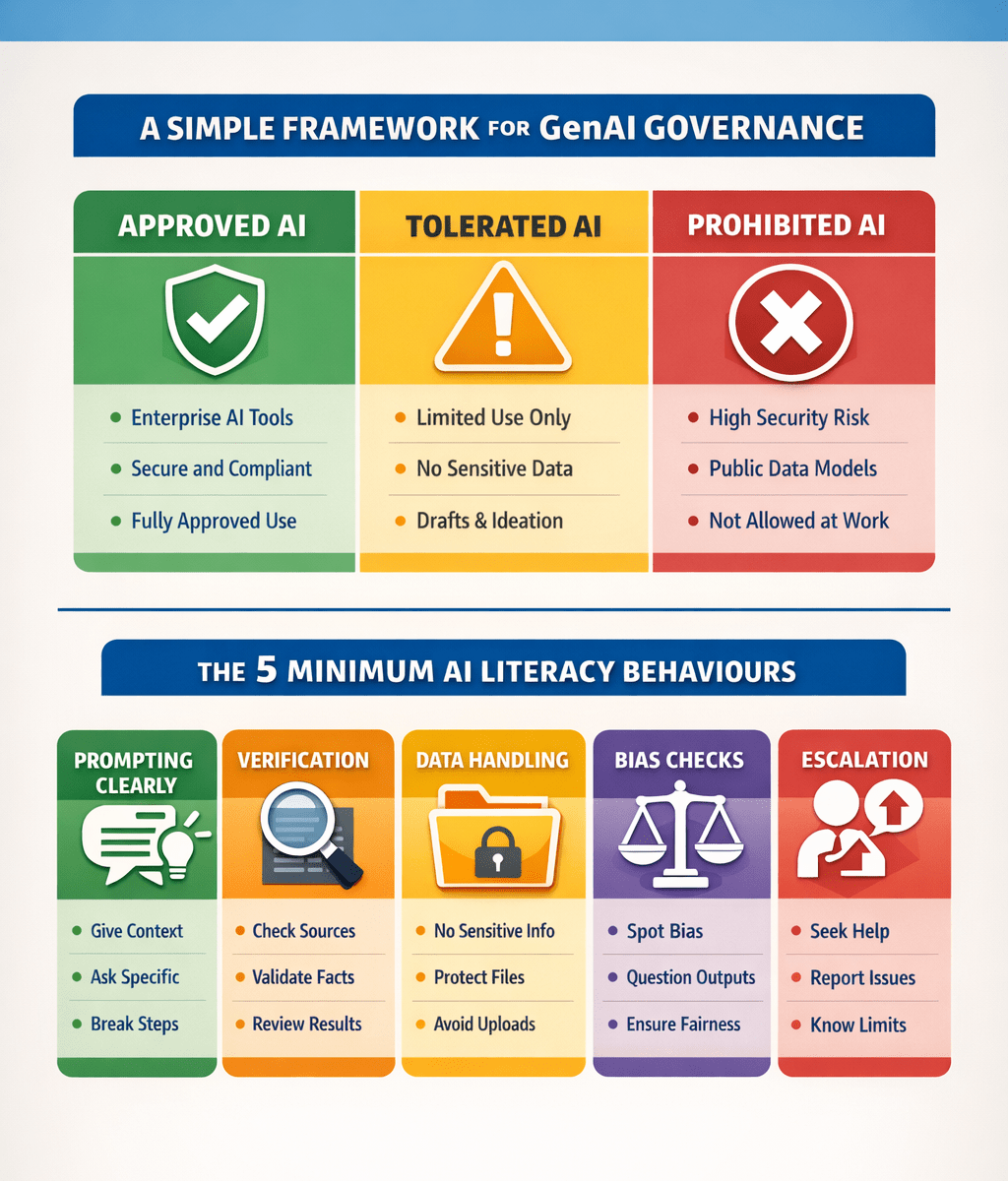
A Simple Framework For GenAI Governance
L&D teams can help simplify governance by teaching employees how to classify AI tools.
A clear taxonomy reduces confusion and encourages responsible use.
1. Approved AI
These tools meet security, privacy, and compliance standards.
Examples include:
- Enterprise AI copilots
- Approved productivity assistants
- Internal AI tools integrated into workflows
Employees should:
- Use these tools freely
- Follow training guidance
- Share best practices with teams
2. Tolerated AI
Some tools are not officially integrated but may be used carefully.
Typical rules include:
- No confidential data
- No customer information
- Use only for early drafts or ideation
This category recognises reality while reducing risk.
3. Prohibited AI
These tools present unacceptable risks.
Examples include:
- AI tools that store training data publicly
- Tools with unclear data handling
- Tools that bypass company security
Employees need to know why these tools are restricted, not just that they are.
Clear explanations increase compliance.
The 5 Minimum AI Literacy Behaviours
Every employee should develop a baseline AI literacy program that covers practical behaviours.
These behaviours dramatically reduce risk.
1. Prompting Clearly
Employees should learn to:
- Provide context
- Ask structured questions
- Break complex tasks into steps
Better prompts produce better outputs.
2. Verification
AI outputs can sound confident but still be wrong.
Employees should:
- Check sources
- Validate facts
- Confirm calculations
AI should assist thinking, not replace it.
3. Data Handling
Workers must know what not to paste into AI.
Training should cover:
- Sensitive data
- Personal information
- Proprietary documents
- Financial or legal records
Many data leaks occur through accidental sharing with AI systems.
4. Bias Checks
AI models reflect patterns in their training data.
Employees should ask:
- Is this output balanced?
- Could it reflect bias?
- Does it represent diverse perspectives?
Critical thinking remains essential.
5. Escalation
Employees should know when to involve humans.
Examples include:
- AI generates questionable advice
- Security concerns arise
- The task affects customers or compliance
Human supervision remains central to safe AI adoption.
Role-Based AI Playbooks
Generic training rarely works. AI literacy becomes powerful when it connects directly to job roles.
Here are practical playbooks L&D teams can build.
HR
HR teams can safely use AI to:
- Draft job descriptions
- Summarise policy updates
- Prepare interview questions
Training should emphasise:
- Avoiding personal data
- Bias awareness
- Candidate privacy
Sales
Sales teams often adopt AI quickly.
Useful tasks include:
- Prospect research
- Email drafting
- Meeting summaries
However, training should reinforce:
- Customer data protection
- Accuracy checks
- Brand voice consistency
Finance
Finance teams must follow stricter controls.
Safe use cases include:
- Explaining financial concepts
- Drafting reports
- Spreadsheet assistance
But employees should never upload sensitive financial data.
People Managers
Managers increasingly use AI to support leadership tasks.
Examples include:
- Preparing feedback
- Planning team meetings
- Drafting communication
Training should highlight:
- Ethical considerations
- Avoiding automated performance decisions
Frontline Employees
Frontline workers benefit from quick guidance tools.
Examples include:
- Customer responses
- Process explanations
- Product information
Short mobile learning modules work best for this group.
How To Spot Shadow AI Early
Organisations rarely detect shadow AI through technology alone.
Instead, behavioural signals often appear first.
Common indicators include:
- Sudden productivity spikes
- Employees referencing unfamiliar tools
- AI-style writing patterns
- Files generated by unknown software
The wrong response is punishment.
The right response is coaching.
Leaders should ask:
- What problem were you trying to solve?
- Which tool helped you?
- How can we support safer use?
This approach builds trust and encourages transparency.
A 30-Day Plan To Launch AI Literacy
L&D teams can move quickly with a structured rollout.
Week 1, Communication
Start with a clear message:
- AI is encouraged
- Responsible use matters
- Training will support safe adoption
This removes fear and confusion.
Week 2, Minimum Training
Launch short modules covering:
- AI basics
- Safe prompting
- Data protection
- Verification practices
Microlearning formats increase completion.
Week 3, Safe Experimentation
Provide employees with:
- Approved AI tools
- Sandbox environments
- Prompt libraries
- Example use cases
People learn fastest through hands-on experience.
Week 4, Measurement
Track adoption and behaviour:
- AI usage rates
- Training completion
- Risk incidents
- Productivity improvements
These insights guide the next phase of your AI literacy program.
Platforms like JLMS Cloud help L&D teams deliver structured AI learning journeys, track adoption, and embed AI capability into daily work.
From Shadow AI To Workforce Capability
Shadow AI reveals something important.
Employees are ready.
They want to use AI because it helps them work better.
The organisations that succeed will not ban AI. They will teach people how to use it safely.
That responsibility now sits with L&D.
When organisations combine governance, role-based learning, and practical training, shadow AI becomes something powerful.
It becomes a workforce capability advantage.
Sources:
Discover more from JZero Solutions
Subscribe to get the latest posts sent to your email.

No responses yet